Creating the university’s official Spanish language style guide was the big first-year project in my current role as Cal Lutheran’s Bilingual Content Producer. This was a result of the university wanting to expand their marketing efforts to its Spanish language audience. It also would serve as a form of standardization and uniformity of the language across campus.
I began this project by compiling every Spanish grammar rule I had learned in my studies, as well as through RAE. One of the biggest mistakes writers make is applying English language grammar rules to Spanish text, so I made sure to explain these in layman terms and provide adequate examples to ease usage. When creating the glossary with typical “university setting” words, I had the hardest time choosing the Spanish translation of “Bachelor’s degree”. This word has so many regional versions, such as “licenciatura” and “bachillerato”, and is interpreted distinctly in almost every country. Ultimately, I took Southern California’s proximity to Mexico’s Spanish dialect and chose “licenciatura”.

Grammar example

“Licenciatura” definition
I had free range on how I wanted to establish Cal Lutheran’s Spanish voice. While I did analyze some previous translations the university had done, the key driver of the voice and tone creation was actually reflecting on my personal experience as a Hispanic first-generation college student. Questions like “What would I have appreciated in Spanish as an incoming student?” “What tone would my parents read and understand best?” This let me segment the university’s Spanish voice into three different tones: students/alumni, families, and general Thousand Oaks community. This would allow for content creators across campus to adjust their Spanish copy accordingly based on their audience.
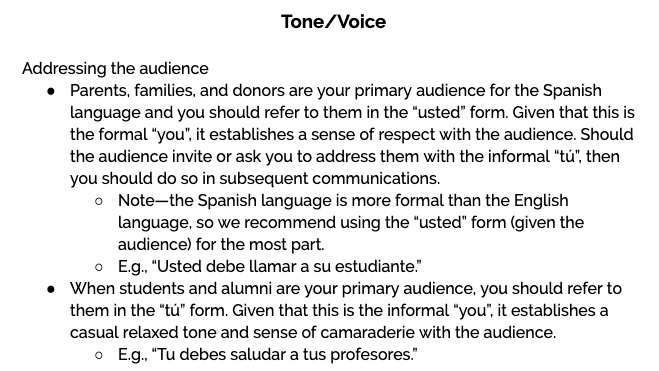
Tone/voice distinction
Upon publishing the style guide, it is periodically updated and distributed to content creators across campus.
La creación de la guía oficial del idioma español de la universidad fue el proyecto predominante en mi primer año como productora de contenido bilingüe de Cal Lutheran. Esto fue al resultado de que la universidad quería expandir sus esfuerzos de marketing en español a su audiencia. También serviría como una forma de estandarización y uniformidad del idioma por todo el campus.
Comencé este proyecto compilando cada regla gramática de español que había aprendido en mis estudios, además por la RAE. Uno de los mayores errores que cometen los escritores es aplicar las reglas de gramática de inglés al texto en español. Así que me aseguré de explicar esto en términos simples y proporcionar ejemplos adecuados para facilitar el uso. Al crear el glosario con palabras típicas universitarias, me costó mucho elegir la traducción de “Bachelor’s degree”. Esta palabra tiene muchas versiones regionales, como “licenciatura” y “bachillerato” y se interpreta distintivamente en casi todos los países. Al fin del día tomé en consideración la proximidad del sur de California con el dialecto español de México y elegí “licenciatura”.
Tuve libertad sobre cómo quería establecer la voz española de Cal Lutheran. Aunque analicé algunas traducciones anteriores de la universidad, el factor clave de la creación de voz y tono fue reflejando en mi experiencia personal como estudiante universitaria hispana de primera generación. Preguntas como ‘¿Qué hubiera apreciado en español como estudiante entrante?’ ‘¿Qué tipo de tono entenderían mejor mis padres’ me guiaron a segmentar la voz española de la universidad en tres tonos diferentes: estudiantes y graduados, familias y la comunidad general de Thousand Oaks. Esto permitiría a los creadores de contenido por todo el campus ajustar sus creaciones en español para sus audiencias perspectivas.
Al publicar esta guía de estilo, se actualiza periódicamente y distribuye a los creadores de contenido por todo el campus.
 Genesis Rodriguez